

The Draa is Morocco’s longest river, technically running over 1,000 kilometres from its source in the High Atlas to where it once reached the Atlantic. In practice, the Draa is dry for most of its length — its water disappears into the sand long before reaching the sea. But for one fertile section, fed by Atlas snowmelt, the river flows above ground and has created one of the longest oases in the world: a continuous palm grove stretching over 200 kilometres from Agdz to M’Hamid.
The classic Draa Valley drive follows the N9 south from Ouarzazate, crossing dry hills before descending into Agdz — the valley’s northern gateway, set beneath the dramatic profile of Jebel Kissane (1,531m). Agdz is small, calm, and a natural first stop: climb to the rooftop of the local kasbah for a sweeping view over the palm groves and surrounding ksour, or wander the orange-tree orchards near its centre.
From Agdz, the road follows the river south, alternating between wide stretches where the palm grove opens onto the horizon and narrower points where cliffs press close to the road. Along the way, a string of villages and kasbahs — Tamnougalt, Timiderte, and others — rise from the green, their walls the same colour as the surrounding earth, as if grown from it rather than built on it.
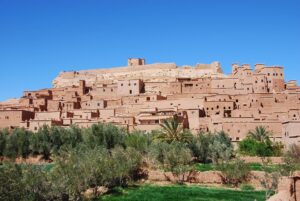
What sets the Draa Valley apart from other kasbah routes in Morocco is that so many of these structures remain genuinely lived-in. Tamnougalt, just 8 kilometres south of Agdz, is one of the oldest continuously inhabited ksour in the valley, dating to the 16th century.
Other kasbahs along the route tell a different story. Many stand abandoned or half-collapsed, their walls visibly melting back into the earth from which they were built — a reminder that pisé (rammed earth) construction was never meant to be permanent.
Zagora itself has long marketed its connection to the Sahara — its famous “Timbuktu 52 Days” sign has photographed generations of travellers — and retains a frontier-town feel where the paved road meets open desert space.
Twenty kilometres further, Tamegroute is home to a centuries-old Quranic library housing manuscripts written in gold ink, alongside a well-known pottery cooperative producing distinctive green-glazed ceramics using techniques passed down through generations.
Beyond Tamegroute, the palm groves gradually thin until they give way entirely to open desert at M’Hamid — the last village before the Sahara proper, and the starting point for 4×4 excursions and camel treks toward Erg Chigaga, one of Morocco’s largest and least-visited dune systems.
The cultivated section of the Draa Valley stretches over 200 kilometres between Agdz, near Ouarzazate, and M’Hamid, at the edge of the Sahara.
Driving the N9 from Agdz to Zagora (roughly 165 kilometres) takes about 2.5 to 3 hours without stops. However, allowing a full day is strongly recommended, as the road itself is one of the main attractions.
The Route of a Thousand Kasbahs is the informal name given to the network of roads through southern Morocco lined with historic earthen fortresses (kasbahs) and fortified villages (ksour). The Draa Valley, particularly the stretch between Agdz and Zagora, is considered its most concentrated and best-preserved section.
Yes. From Zagora, the Draa Valley continues south through Tamegroute to M’Hamid, the last village before the open desert. From M’Hamid, 4×4 vehicles and camel treks reach Erg Chigaga, one of Morocco’s largest and most remote dune systems, where overnight desert camps are widely available.
October to April is considered ideal, with mild daytime temperatures suited to walking through the palm groves and visiting kasbahs. Summer temperatures regularly exceed 40°C, making midday activity uncomfortable, though early mornings and evenings remain pleasant.
Many are. Villages such as Tamnougalt near Agdz remain continuously inhabited ksour, with functioning mosques, grain stores, and communal spaces still in daily use. Others have been partially abandoned as residents move to modern housing nearby, while some have been restored as guesthouses or cultural centres.
From a focused day trip out of Ouarzazate to a multi-day journey continuing to M’Hamid and the dunes of Erg Chigaga, Ergaventure designs the route around your time and interests.
Feel free to ask us any questions.
 +212 661-414956