



Why Go Off the Beaten Path in Morocco?
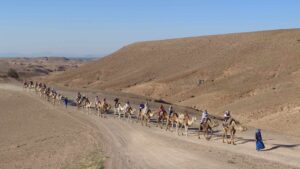
Morocco’s geography is far larger and more varied than its tourism map suggests. South of the High Atlas, the Anti-Atlas range stretches for hundreds of kilometres — a landscape of pink and ochre granite, terraced almond orchards, and Amazigh villages built into hillsides that have barely changed in centuries. Further east, the Jebel Saghro massif rises between the Dades and Draa valleys: a volcanic wilderness of rock spires and nomadic camps .
Route Overview
This route begins and ends near Marrakech or Agadir (both work well as start/end points), forming a loop through five distinct regions. Here’s the shape of the journey before the day-by-day detail:
Day 1-2
Anti-Atlas Crossing
Marrakech → Taroudant → Tafraoute
Day 3-4
Tafraoute & Ameln Valley
Pink granite, Painted Rocks
Day 5
Sidi Ifni
Atlantic coast detour
Day 6-7
Anti-Atlas Interior
Igherm, remote villages
Day 8-9
Jebel Saghro
Volcanic peaks, nomad camps
Day 10
Skoura Oasis
Palm groves & kasbahs
Day 11-12
Dades & Return
Valley of Roses → Marrakech
Day-by-Day Itinerary (12 Days)
Each day includes built-in flexibility for hikes, detours, and the inevitable invitation for tea that tends to derail (in the best way) any fixed schedule.
Marrakech → Taroudant → Foothills of the Anti-Atlas
Leaving the well-trodden road behind
Depart Marrakech heading south over the Tizi n’Test pass — a quieter, more dramatic alternative to the better-known Tizi n’Tichka, winding through cedar forests and Berber villages. Stop in Taroudant, walkable medina and an excellent introduction to the slower pace ahead. Continue toward the foothills of the Anti-Atlas for the night.
Taroudant Area → Tafraoute
Entering the pink granite world of the Anti-Atlas
The drive into Tafraoute is itself a destination: the road climbs through increasingly rugged Anti-Atlas terrain, almond and argan groves giving way to vast outcrops of pink and rose-coloured granite that seem to glow under the afternoon sun. Arrive in Tafraoute with time to walk through the town’s quiet streets and settle into the rhythm of a place built around granite, almonds, and very little else.
Tafraoute — The Painted Rocks & Aguerd-Oudad
A surreal art installation in the middle of the desert
A short drive and walk brings you to the famous Painted Rocks — a sprawling collection of granite boulders painted in bold blues, reds, now weathered into the landscape itself.
Ameln Valley Hike
A full day on foot through one of Morocco’s quietest valleys
A full-day walk through the valley floor passes through a string of stone Berber villages and palm oases.
Trails range from gentle valley paths to steeper climbs for those wanting mountain views — your guide adjusts the route to your pace.
Tafraoute → Sidi Ifni
From pink granite to Atlantic cliffs
A scenic drive west through the Anti-Atlas brings you to the Atlantic coast at Sidi Ifni . The town’s unhurried, slightly melancholic atmosphere — locals describe it as having its own particular rhythm — makes for a complete change of pace after the mountains.
Sidi Ifni → Igherm → Anti-Atlas Interior
Into the deep interior of the Anti-Atlas
Heading back inland and east, the route passes through Igherm before continuing into a remote stretch of the Anti-Atlas interior .
Anti-Atlas Interior → Toward Jebel Saghro
Transition day: from granite peaks to volcanic wilderness
A longer transit day east, gradually leaving the Anti-Atlas and entering the approach to Jebel Saghro — a complete shift in landscape, from the rounded pink granite of Tafraoute to the jagged, dark volcanic rock formations that define this region.
Jebel Saghro — Bab n’Ali Pinnacles
Hiking among rock spires that feel otherworldly
A full day exploring the heart of Jebel Saghro, centred on the Bab n’Ali pinnacles — a series of dramatic rock towers rising abruptly from the valley floor, often compared to formations in the American Southwest, though entirely unique in character.
The hike to the base of the pinnacles takes 2-4 hours depending on the route chosen, through a landscape of volcanic scree, scattered juniper trees, and the seasonal camps of Aït Atta nomads, who have grazed livestock through this region for generations.
Jebel Saghro — Tagmout Valley & Nomad Encounters
A second day in the Saghro, at a gentler pace
A shorter, more relaxed day exploring the Tagmout Valley and the surrounding plateau — gentler walking among scattered Aït Atta encampments, with opportunities (never forced, always led by genuine welcome) to share tea and conversation with nomadic families.
This day is as much about pace as place: after eight days of movement, the Saghro plateau offers space to simply sit with the landscape. Afternoon transfer toward Skoura.
Skoura Oasis
Palm groves and centuries-old kasbahs
The Skoura Oasis, near Ouarzazate, is one of Morocco’s most extensive palm groves — a green labyrinth of date palms, pomegranate trees, and irrigation channels (seguias) shading dozens of historic earthen kasbahs.
A gentle walking day through the oasis includes a visit to Kasbah Amridil, a beautifully preserved 17th-century fortified house that has featured on Moroccan banknotes, and time to meet local farming families whose techniques have barely changed in centuries.
Skoura → Dades Valley → Valley of Roses
Rose gardens and rugged canyon scenery
Heading north into the Dades Valley, the route passes through the Valley of Roses around El Kelaa M’Gouna — spectacular if timed for the rose harvest in late April/early May, but beautiful year-round for its terraced gardens and mountain backdrop. The Dades Valley itself is famous for its eroded rock formations, sometimes called the “Valley of Human Bodies” or “Monkey Fingers” for their strange organic shapes.
Overnight in the valley with views of the surrounding kasbahs and rosy-hued cliffs.
Dades Valley → Ouarzazate → Tizi n’Tichka → Marrakech
The journey home, with one last mountain crossing
The final day retraces familiar Moroccan ground but after eleven days in the country’s quieter corners, even this more travelled route feels different: a reminder of how much lies beyond it.
Arrive in Marrakech by late afternoon, with time for a final dinner in the medina before departure or onward travel.

 +212 661-414956